

MSU social work professor Fei Sun explains how AI can support people with dementia and their caregivers while keeping human connection, accessibility and public advocacy at the center of care.
Artificial intelligence can help a caregiver find information and resources about disease treatment and care, suggest ways to approach a difficult task, and provide a space for emotional conversation. But knowing how to help someone is not the same as being there to help them.
That distinction matters in dementia care, where support involves more than answering questions.

For Fei Sun, a professor at Michigan State University’s School of Social Work, AI’s potential lies in helping people provide care, and not replacing the relationships that make that care meaningful.
His perspective centers on a practical question: How can technology make life better for people with dementia and their caregivers without adding more challenges to their day?
What AI can offer
Sun sees opportunities for AI to help caregivers find information, organize questions and navigate some of the demands of caregiving. Conversational tools may also offer reassurance or a sense of companionship, depending on the person and the situation.
But those uses are not interchangeable, and neither are the people using them.
“Someone in an early stage of dementia may engage with a conversational tool differently than someone whose condition has more substantially affected their ability to communicate,” Sun said. A tool that works for one person may not be useful to another.
The distinction also applies to caregivers.
An AI tool might suggest an approach to a daily care task, but a person still has to provide that care. Information alone cannot take over the physical responsibilities of helping someone throughout the day.
Sun described these technologies as tools that family caregivers and direct care workers can use to assist their work. Their value depends on whether they offer useful support in a person’s actual circumstances.
The connection a response cannot replace
An AI-generated response can sound understanding. It may acknowledge frustration or offer encouraging words. But Sun wants to distinguish that exchange from the experience of being with another person.
“I would think the biggest difference is the personal connection,” he said.
For people with dementia, he explained, care involves sensory and emotional experiences as well as conversation: hearing a familiar voice, seeing someone’s expression or feeling a reassuring touch. These experiences draw on relationships and a shared personal history.
A person holding someone’s hand offers physical presence and the ability to respond to subtle changes in comfort or distress. A chatbot’s reassuring words cannot replace that personal, sensory experience.
“Those human interactions are really missing when you interact with AI,” Sun said.
That does not mean digital tools have no place in care, however. Sun emphasized the convenience technology can offer people who have difficulty traveling or accessing services. But convenience should not obscure what is missing when human interaction is reduced.
For Sun, technology should support relationships and create more opportunities for meaningful human contact. A convincing conversation should not become a reason to reduce that contact.
Help should not become another burden
For Sun, technology has to meet people where they are. Before introducing a tool, caregivers and professionals should consider the person’s cognitive abilities, language, cultural background and daily routines, along with what the tool asks of them.
Learning an unfamiliar system takes time. Subscription costs, internet access and comfort with technology can also determine whether a tool is practical. A useful design should fit the person’s circumstances and allow for support from a caregiver when needed.
“We cannot assume this technology is accessible,” Sun said.
For a caregiver already managing substantial responsibilities, another platform to learn or troubleshoot may create work rather than reduce it. Sun said the benefits must be weighed against those demands. People who cannot or prefer not to use digital tools still need accessible ways to obtain support.
Privacy also deserves attention. He urged users to understand how a platform handles the information they share and to be cautious about entering sensitive personal or financial details.
These questions reflect a broader social work concern: Who benefits from a technology, and who may struggle to access it or bear its risks?
A more meaningful role for technology
“For individuals, AI tools are useful when they are accessible, easy to use and address a real challenge in daily life,” Sun said.
For Sun, the possibilities extend beyond creating a machine that can hold a conversation.
He is interested in whether AI and related technologies can help people with dementia or other disabilities participate in experiences that would otherwise be difficult to access. He offered an example of someone with limited mobility experiencing a museum without having to travel there.
The value would not simply be that the technology could respond. It would be that it helped someone pursue an interest or experience more of the world.
“Whether AI can help them open the door to more opportunities,” Sun said, “that’s what I’m going to focus on.” Despite growing interest in this field, more research is needed in this area.
Public awareness and policy support
“For society, the AI’s value lies in helping to break down structural barriers and promoting equitable access to support,” Sun said.
Sun also emphasizes public awareness and policy advocacy as part of improving dementia care. Better tools alone cannot address stigma, help families recognize where to seek support, or ensure that services are available and affordable. Public education can help communities better understand dementia and include people living with it.
For Sun, policy priorities include support for family caregivers, a prepared dementia care workforce and equitable access to services. As technology develops, those priorities should guide decisions about how it is designed, funded and used.
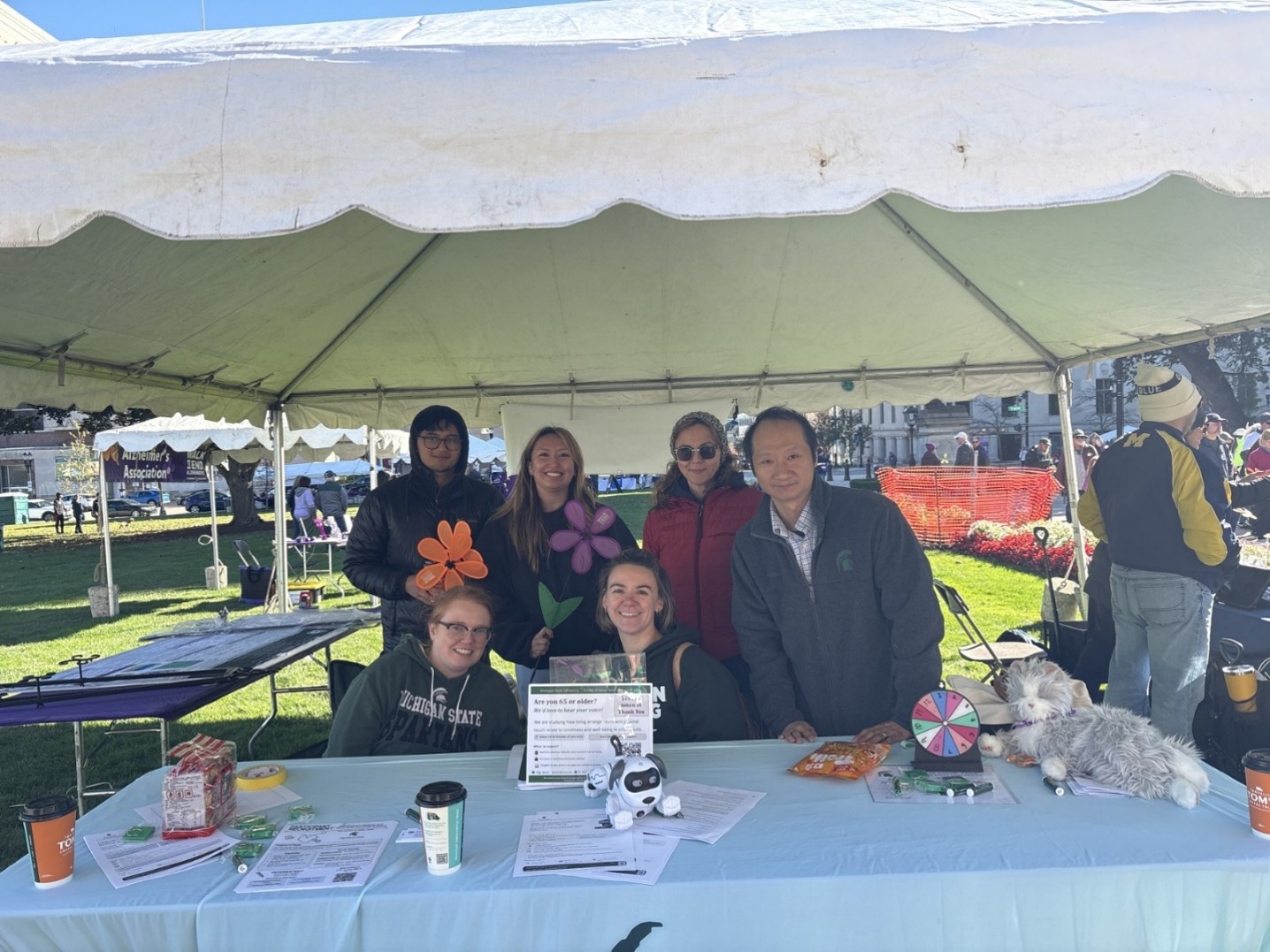
His lab participates in an annual Alzheimer’s walk, reflecting the importance of connecting research with community engagement. The event offers a setting to bring dementia into public view and connect with people affected by it.
Citation: Chen, X. S., Jiang, L., Sun, F., & Feng, Y. (2026). Artificial intelligence-based social assistive robots in dementia care: A systematic review and meta-analysis. The Gerontologist, 66(5), gnag019.